 (No Ratings Yet)
 Loading...
Income claims about adult content creators run from a few dollars a month to seven figures, and almost none arrive with the context needed to judge them. A screenshot of a record payout says little about the thousands of accounts that earn next to nothing. Reading the numbers properly starts with separating gross from net, and the visible few from the silent many.
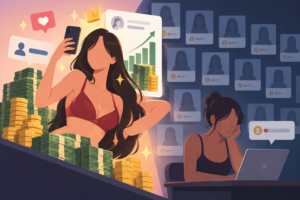
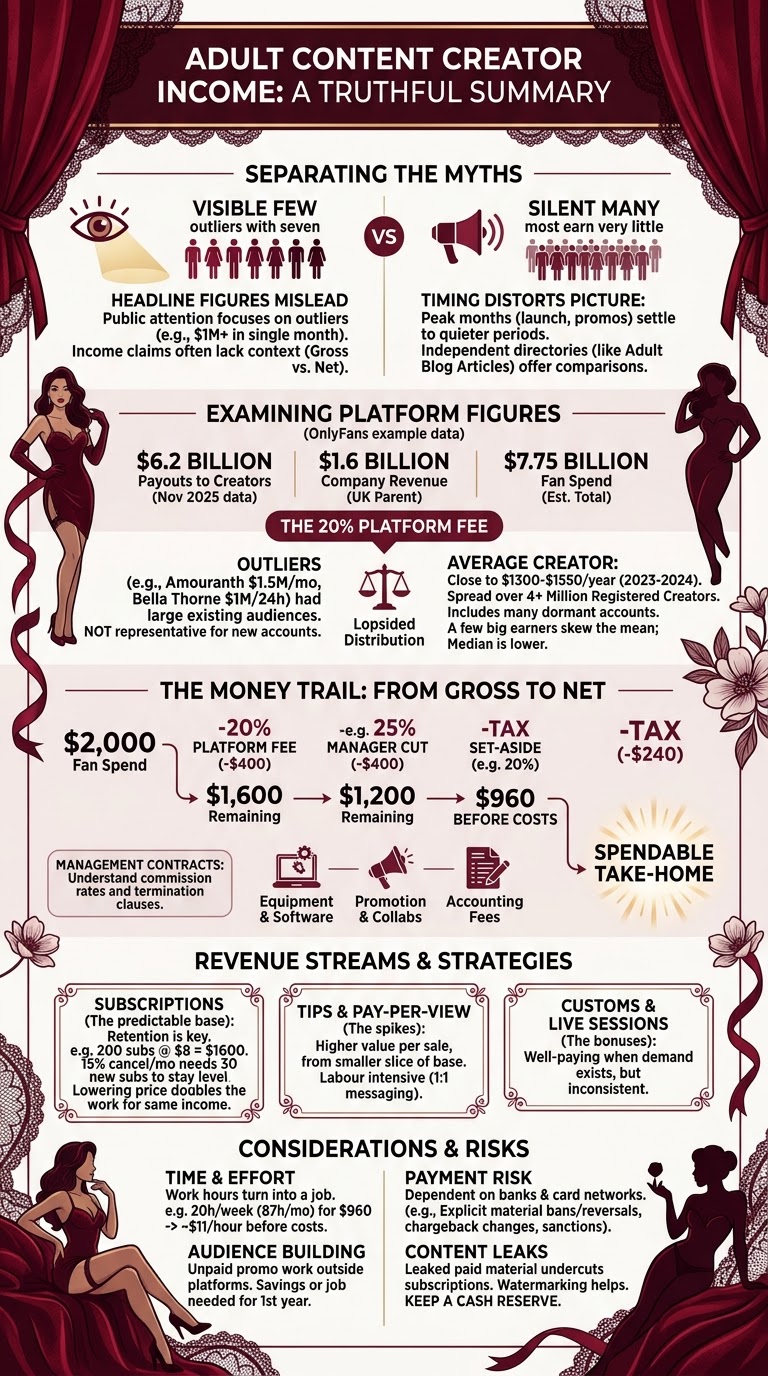
Public attention gravitates toward outliers. A creator who reports a million dollars in a single month gets coverage, while the account that earned forty dollars in its first quarter gets none. Creators also have every incentive to talk big, since a large number attracts subscribers, collaborators and management offers, which explains the polished earnings threads that circulate on social media. Because platforms rarely publish a full distribution of earnings, the loudest numbers end up defining what outsiders assume is normal.
Anyone weighing this as a career should treat an income screenshot like one glowing product review. It is interesting, and it is not representative. Independent adult directories, including Adult Blog Articles, are a sensible place to compare platforms and income models before committing months of effort to any single one of them.
Timing distorts the picture as well. Earnings quoted for a peak month, such as a launch week backed by a heavy promotional push, say nothing about the quieter months that follow, when subscribers lapse and revenue settles well below the spike. A creator who quotes an annual income by dividing by twelve hides the same unevenness.
The best public data comes from the largest subscription platform, OnlyFans, whose UK parent company files accounts that journalists then report on. For the year to November 2025 the company posted revenue of about $1.6 billion, up 10 percent, while roughly $6.2 billion was paid out to creators, according to the OnlyFans entry on Wikipedia.
The two figures fit the platform’s 20 percent fee. If creators received 80 percent and that share came to $6.2 billion, fans spent about $7.75 billion in total, and 20 percent of that is roughly $1.55 billion, which matches the reported revenue.
At the far end, a few outliers are documented in the press. The streamer Amouranth told Business Insider in 2022 that she was earning about $1.5 million a month on the platform, and Bella Thorne reported $1 million within her first 24 hours in 2020. Both arrived with large existing audiences, which makes them poor guides to what a typical new account can expect.
The same entry puts the average creator at nearly $1,300 a year for 2023 and counts more than four million registered creators as of 2024. Dividing $6.2 billion by four million accounts gives no more than about $1,550, close to that reported average, even though the registered count includes dormant profiles and the number of active earners is smaller. Billions of dollars spread across millions of profiles leave a modest mean, and a handful of very large earners pull even that mean upward. In a distribution this lopsided the median sits below the mean, although platforms do not publish it.
Cumulative totals look even more impressive. In October 2025 the company announced that it had paid creators $25 billion since 2016, and later press coverage put the figure near $30 billion by August 2026. Those sums sound like a gold rush until they are stretched across ten years and millions of accounts.
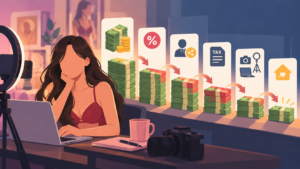
The platform keeps 20 percent of what fans spend, so every $1,000 in fan payments becomes $800 before anything else happens. Gross figures quoted in interviews rarely mention that cut, and they almost never mention what follows it.
Tax needs particular attention because payouts generally arrive in full, with nothing withheld the way an employer would withhold from a salary. In most countries the creator must register as self employed, set money aside and file, and a bill that lands months later is a common source of trouble. Several other deductions sit between the payout and the bank balance:
Consider a hypothetical creator whose fans spend $2,000 in a month. After the platform fee that is $1,600. A manager taking 25 percent leaves $1,200, and setting aside another 20 percent for tax brings the figure to $960 before a single piece of equipment is paid for. Every extra service a creator buys in lowers the spendable figure further.
Management contracts deserve a careful read. Commission rates are set by agreement, and some arrangements continue to take a share of earnings after the creator leaves, so the termination clause matters as much as the headline percentage. A manager who brings in new subscribers can be worth the cut, but only if the numbers after the cut are higher than they were before.
Subscriptions form the predictable base of most accounts, and retention matters more than the sticker price. Picture 200 subscribers paying $8 a month, which is $1,600 gross. If 15 percent of them cancel each month, the creator has to find 30 new subscribers every thirty days just to stay level. Halving the price to $4 would need twice the subscribers to earn the same $1,600.
Tips and pay-per-view messages tend to produce the spikes. They convert only a slice of the subscriber base, but each sale is worth more than a monthly fee, so creators who message their audience directly often earn well above what the subscription price alone would suggest. That income is also the most labour intensive, since it depends on a steady flow of one to one conversation.
Custom requests and live sessions round out the picture. They pay well per hour when demand exists and nothing when it does not, and creators tend to treat them as a bonus rather than a salary.
Most new accounts start with no audience. Because discovery inside subscription platforms is limited, many creators bring their own traffic from social networks, and that promotional work is unpaid, daily and slow to compound. The first months commonly produce more effort than income, so a day job or savings that cover six months of living costs matter more than any single post.
Regular posting keeps subscribers from cancelling, but it turns the account into a job with deadlines. A creator who works roughly twenty hours a week, about 87 hours a month, and ends up with the $960 from the example above is earning around $11 an hour before costs. Investigations published in 2024 found that many creators paid chatters, or used automated tools, to handle subscriber messages. Outsourcing buys back time, but it hands a further slice of revenue to someone else and raises legal questions, since the platform’s terms prohibit chatbots and make creators responsible for every transaction with a subscriber.
Creator income depends on banks and card networks that the creator never deals with directly. In August 2021 OnlyFans announced a ban on sexually explicit material, blaming pressure from banks and payment partners, and reversed course six days later after a backlash from users. For those six days, creators had to plan around a platform that might soon stop allowing what they sold.
Smaller shocks have landed as well. After a celebrity launch in 2020 was followed by a wave of chargebacks, the platform limited what creators could charge for tips and pay-per-view content and how quickly payouts arrived, though it said the changes were unrelated to that launch. Creators in Russia and Belarus reported in 2022 that they could not withdraw funds after sanctions restricted payment methods, and access was restored later.
Leaks add a quieter drain. In 2020 BuzzFeed News reported that terabytes of creators’ content had circulated on social media, which OnlyFans said did not come from a breach of its systems. Paid material that is copied and reposted for free undercuts subscriptions, and watermarking clips will not stop the copying but does make takedown requests quicker to file. Creators who keep a cash reserve covering a couple of months of expenses absorb changes like these far better than those who spend every payout the day it lands.